Equipment · Automatic Tank Cleaning
ATC unit — rental & purchase
An Oil & Gas equipment category for rental or purchase. This overview explains the automatic closed-loop cleaning principle; it does not confirm the availability, configuration or performance of a specific unit.
The closed loop
Fluid returns to the process.
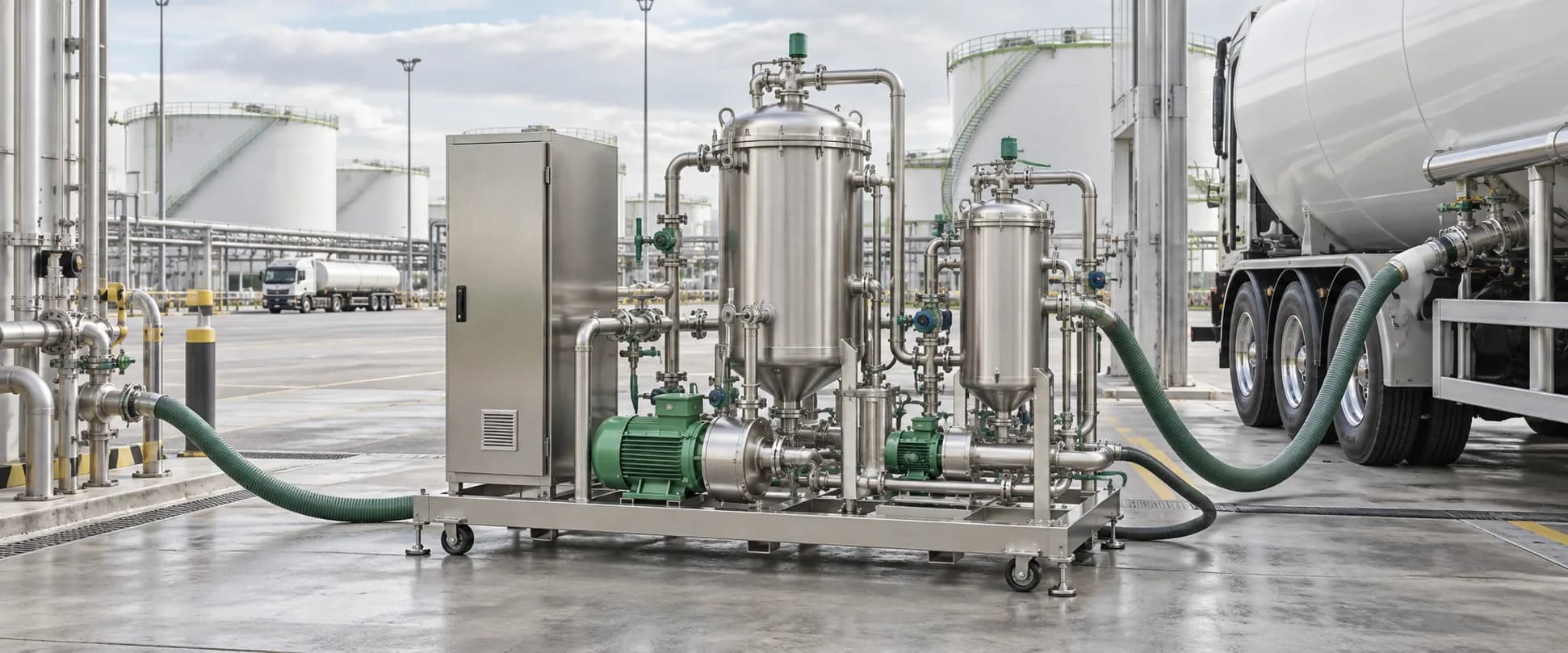
From the skid to the cleaning heads inside the tank, returning as slop to be separated and recirculated. One controlled loop, designed to reduce or avoid entry during the automatic cycle where the configuration permits.
Choose how you want to access the equipment.
For rental, specify the period and operating conditions. For purchase, set out the requirements and documentation needed. This page has no live stock, automatic pricing or booking.
Have a unit to sell or share? You can prepare a proposal. Sharing requires a suitable asset, the owner's approval and an agreement between the parties.
The form produces a local summary, with no automatic submission or commercial commitment.
What it is
How an automatic cleaning system works.
Tank Cleaning Machines (TCMs) are positioned in the tank according to its geometry and access points.
An on-site skid combines pumps, dedicated cleaning chemistry and a separation system: the operation's process core.
Cleaning fluid is recirculated in a closed loop — recovered as slop, separated from solids and returned to circulation.
The cleaning cycle is operated and controlled from outside, with the aim of avoiding operator entry where the configuration and operating stages permit.
Why it matters
Three factors to assess for your application.
Safety
Assess the entries needed for installation, cleaning and inspection. External operation is an objective where technically possible, not a guarantee of no hazards or tank entries.
Competence and supervision
Team size, qualifications and supervision depend on the unit, the site and the work assessment. They must be established before mobilisation.
Operating window
Plan setup, cleaning and final checks using the tank and residue data. We do not quote a standard duration or guaranteed time saving.
Configurations
Application contexts to assess.
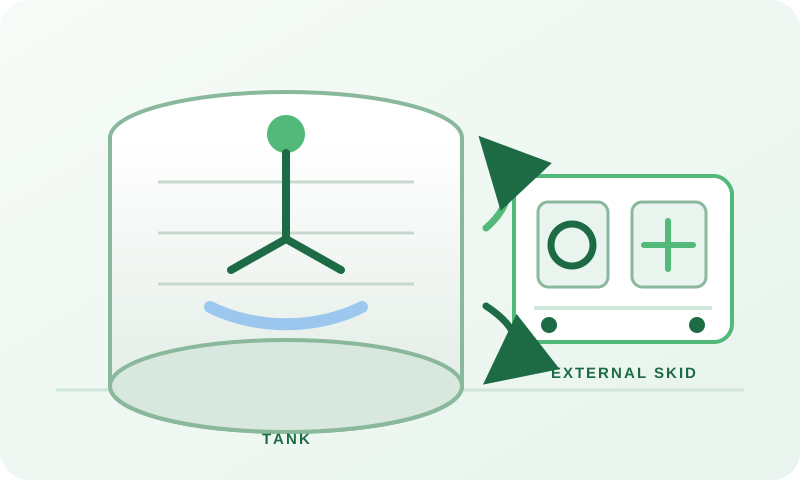
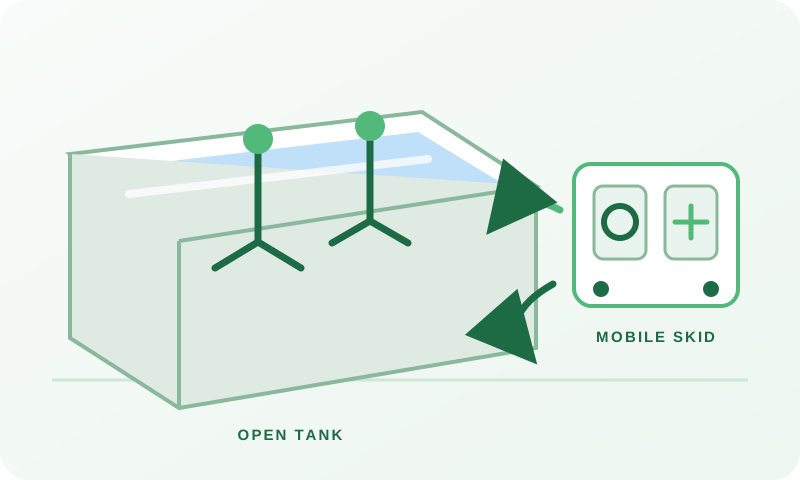
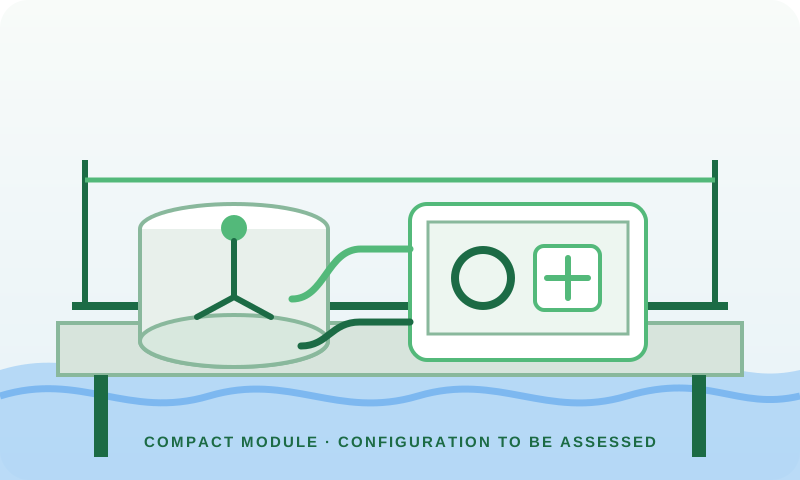
These diagrams illustrate possible applications, not available units or confirmed suitability. Dimensions, compatibility and documentation must be checked for the selected model.
A
Onshore · storage tanks
Fixed storage tanks at refineries, depots or terminals: a common configuration for substantial volumes and accumulated residues.
B
Open tanks and pits
Open-air basins and pits, where cleaning-head access and recovered slop management are key.
C
Offshore / mobile
Mobile and offshore applications, with footprint, weight and mobilisation constraints assessed case by case.
How it works
From positioning to disposal, six steps.
- 01
Positioning the TCMs
Cleaning machines are positioned in the tank according to its geometry and available access points.
- 02
Programmed wall jets
Jet patterns and pressure are set to cover the walls and floor in line with the cleaning objective.
- 03
Slop extraction
Residue-laden fluid is extracted from the bottom and transferred to the process skid.
- 04
Solids/liquid separation
At the skid, the flow is separated: solids on one side and clarified liquid on the other.
- 05
Fluid reuse
Recovered liquid can return to the circuit where the process allows; makeup fluid and consumption depend on actual conditions.
- 06
Residue management
Collection, disposal routes and responsibility for residues must be defined in the work plan; they are not automatically included in rental or purchase.
Technical data
Technical specifications
| Cleaning flow rate | — |
|---|---|
| Operating pressure | — |
| Skid dimensions | — |
| Weight | — |
| Power supply | — |
| Tank capacity range | — |
| Certifications (ATEX/CE) | — |
Data has not yet been validated: dashes indicate unavailable information. This page does not confirm certification, a final datasheet or unit availability.
Equipment & services
Agree the support around your equipment.
Rental and purchase are the two routes to the unit. Operational support, parts and training are separate requirements, subject to assessment and an agreed scope.
Related resources
Technical documentation to confirm.
Request model data, unit condition, manuals and applicable documentation before making a decision. Final datasheets and operating results will only be published when available and verified.
Prepare your equipment enquiry.
Rental, sharing, purchase or sale: gather specifications and requirements in a document to share with your agreed contact.